On the wheel
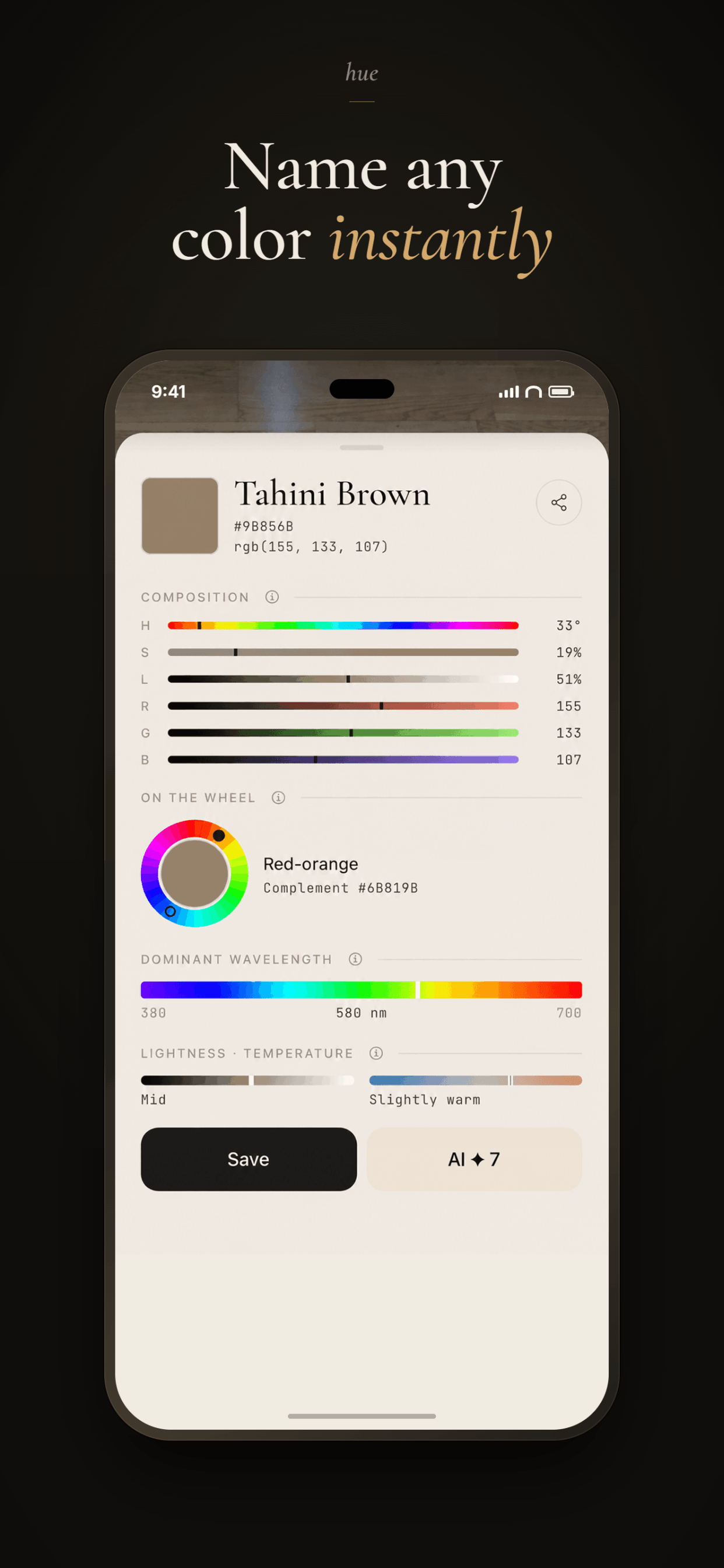
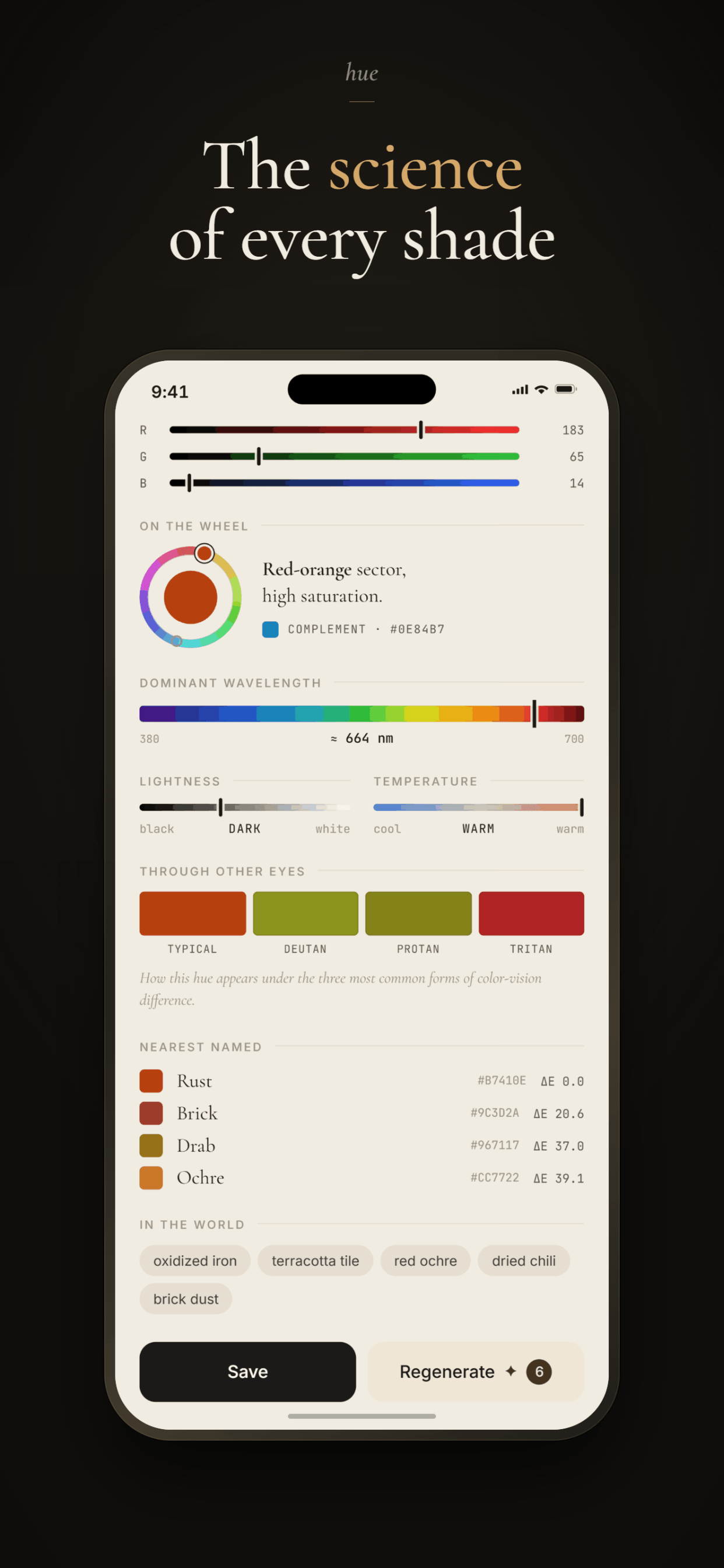
See your color's place on the color wheel, its sector name, and its complement — the color sitting exactly opposite.
The science of color
Point your camera at anything — a peony, a wall, a Tuesday sweater — and hue reads it back to you in HSL, wavelength, complement, named ancestry, and the way it looks through someone else's eyes. A camera color scanner and identifier — HEX, RGB, color names, all on-device.
What it sees
Six lenses on a single sample — a color identifier that goes far beyond a hex code. Each one a different way of asking what is this color, really?
See your color's place on the color wheel, its sector name, and its complement — the color sitting exactly opposite.
From near-ultraviolet violet to deep red, every hue has a nanometer. We mark yours on the visible spectrum.
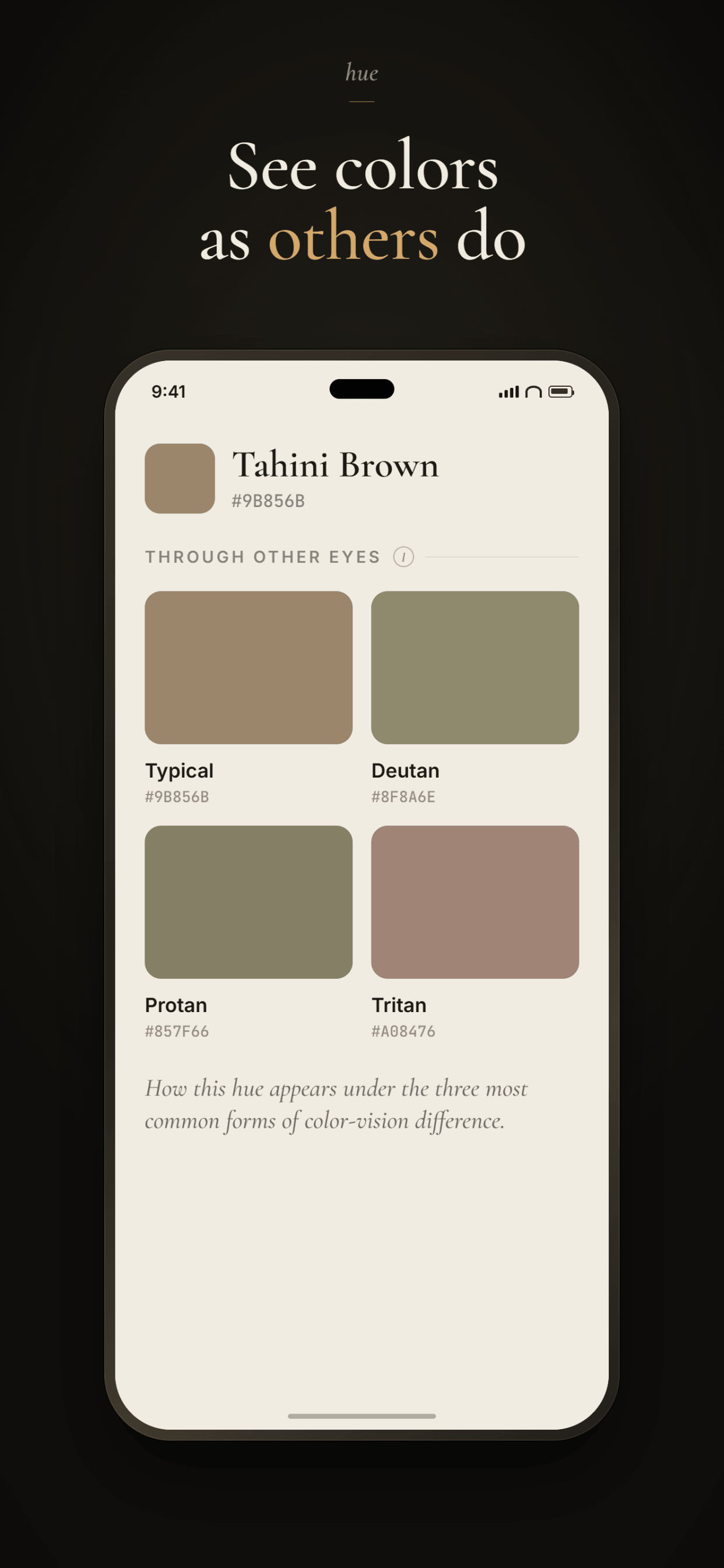
A colorblind preview: see your color the way someone with deuteranopia, protanopia, or tritanopia does. Design for everyone.
Match against a curated library of thousands of named colors, with the nearest ranked by perceptual ΔE distance.
One poetic line that captures the feeling of a color — "the green of moss that has waited out three winters."
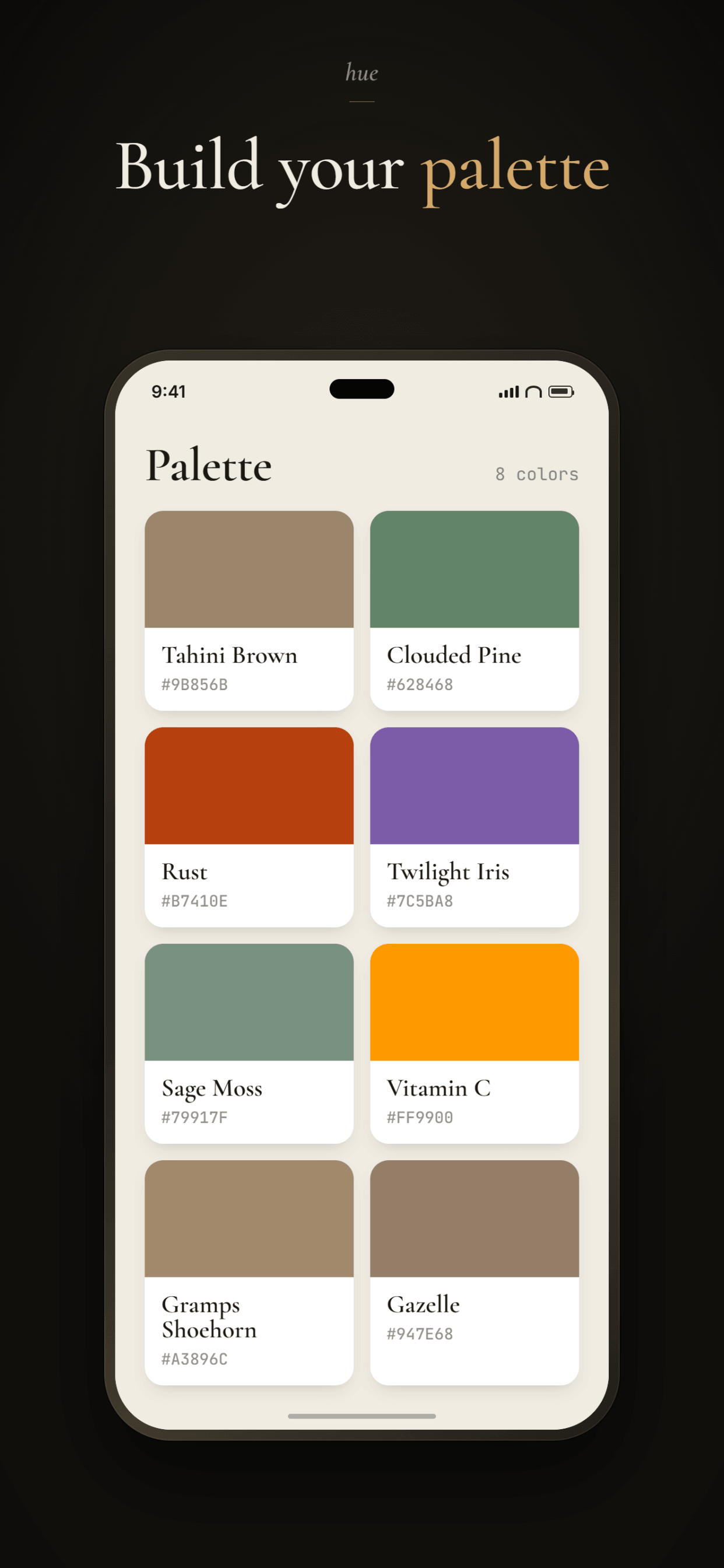
Save every color you capture to an unlimited color palette, revisit it any time, and share a color as its name and HEX with one tap.
How it works
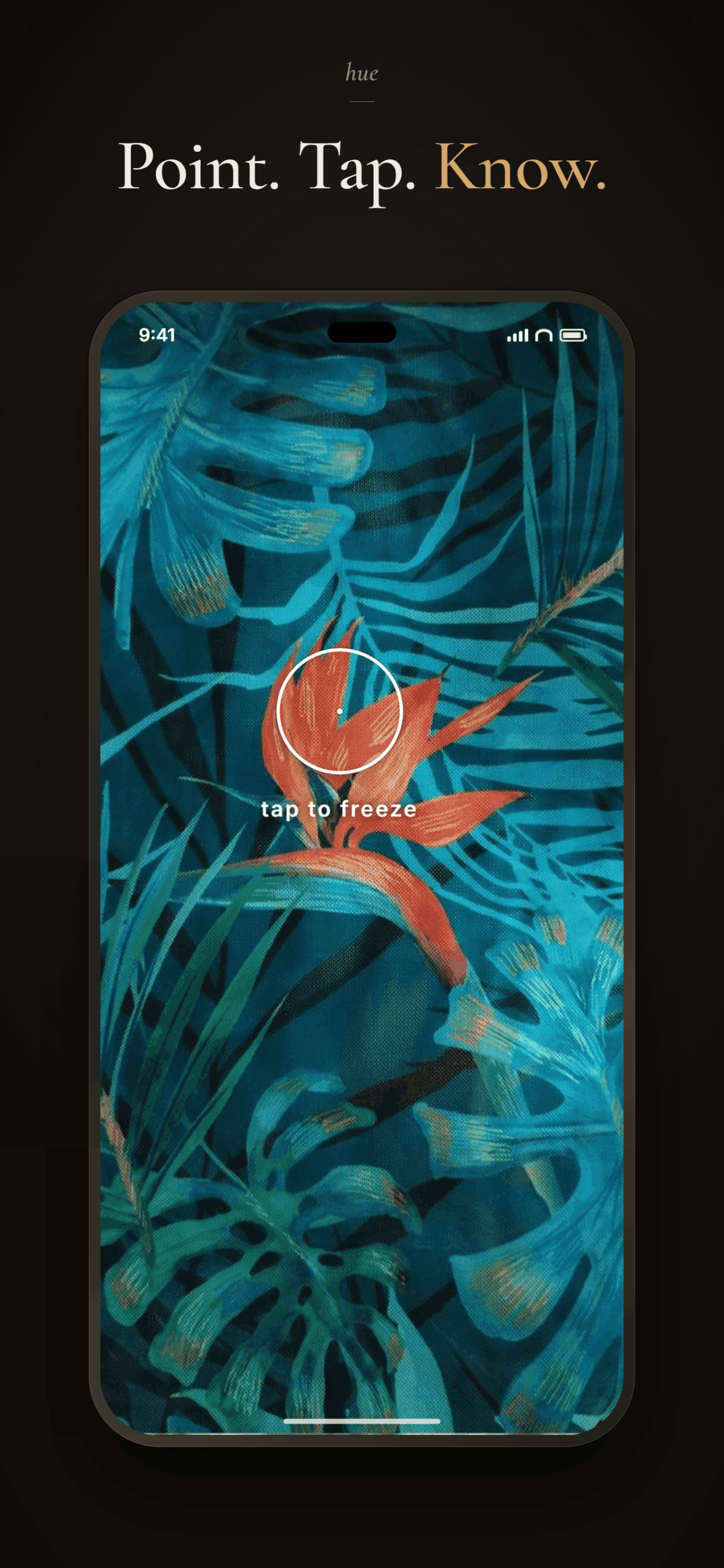
Hold the camera steady on what you want to read. Hue averages a small patch to ignore noise.
The scientific card slides up. Hex, HSL, RGB, sector, complement — on-device, with no waiting.
Pin it to a palette. Share it as its name and HEX. Then take it shopping: compare it live against paint or fabric.
Take it shopping
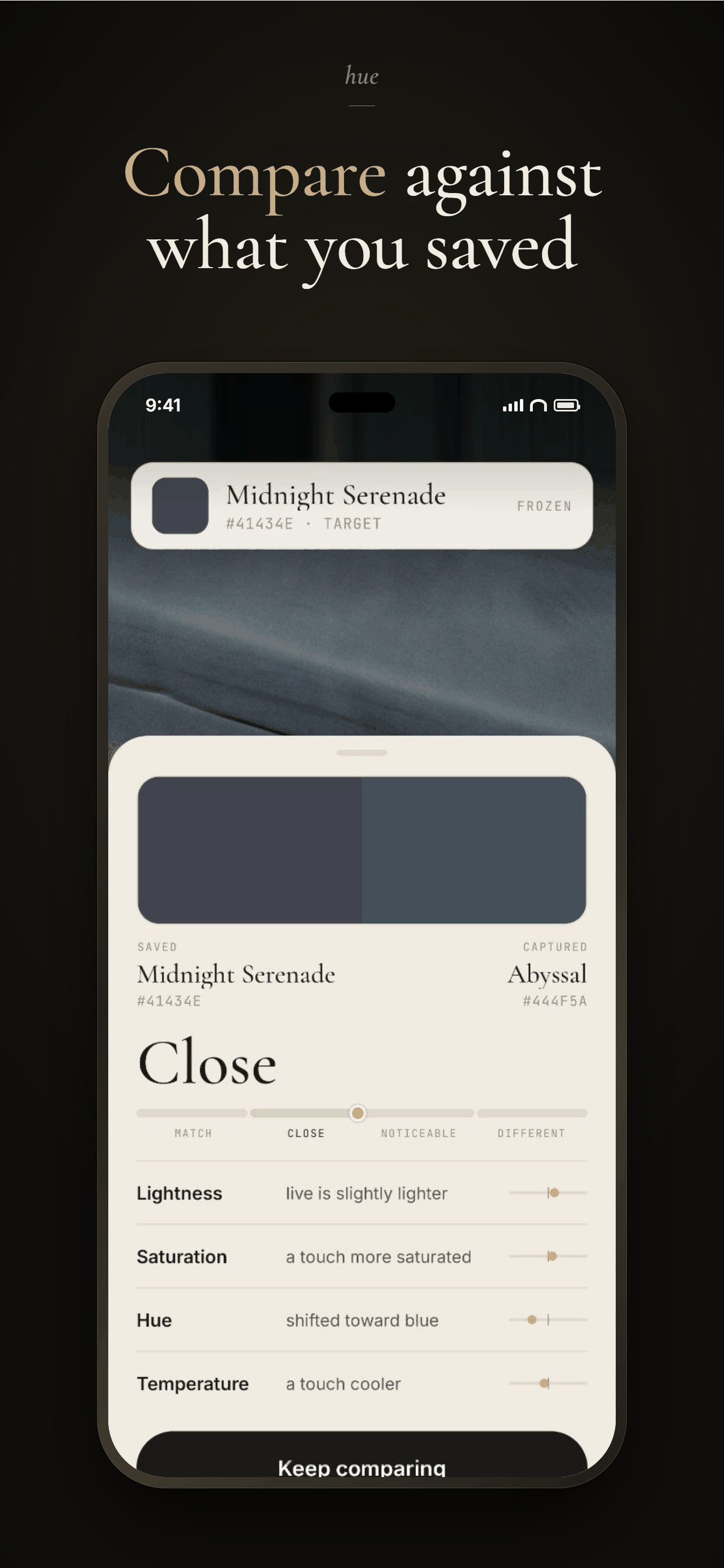
Save the wallpaper at home. At the store, open it from your palette, point the camera at a paint can, and hue keeps score in real time: Match, Close, Noticeable or Different. Tap to freeze and see exactly how the two colors differ, by lightness, saturation, hue and temperature.
Part of hue Pro, included in the free trial. Compare under similar lighting for the fairest verdict.
See it in action
Hue Pro
Free hue gets you the color, the name, and the closest cousins. Pro unlocks the entire instrument panel — the parts a colorist actually uses.
Common questions
Yes. The core camera-to-color reader, named matches, and saved palettes are free forever. Pro is a small optional subscription that unlocks the full scientific card and AI descriptions.
Color reading and the entire scientific card run on-device. The only thing that needs a network is the AI essence — everything else works in airplane mode.
We sample a calibrated patch (not a single pixel) and correct for white balance using the surrounding scene. For absolute color work, a hardware spectrophotometer is still the right tool, but hue is faster, free, and lives in your pocket.
Yes: that is Compare live. Open a saved color in your palette, point the camera at the paint can, and hue shows Match, Close, Noticeable or Different in real time, with a breakdown by lightness, saturation, hue and temperature. It is part of hue Pro (free during the trial), and works best under similar lighting.
Every color you capture can be saved to an unlimited palette, and shared as its name and HEX value with one tap. Export to design-tool formats is on the roadmap, not in the app yet.
Camera frames never leave your device. Your saved palette is stored locally on the phone, with no account and no cloud sync. AI descriptions send the hex value — nothing else.
hue runs on Android phones and tablets today, and on iPhone via the App Store. Layouts tuned for larger screens are on the roadmap.